Today (Sunday) was a free day for the team, nothing was organised but most of us wanted to go back to the Russian Markets for some more shopping. So after breakfast we called for the tuk tuks and headed off! Sean & Dan had other plans, so they set off to do their own thing. The markets were only just opening as we arrived, we quickly found the two NGO/Free Trade shops we had been looking for. There are a number of organisations that work mainly with kids and women, teaching them skills, providing work and an outlet for their craft. They are considered 'free trade' as they ensure that the workers are paid a fair wage for their work. The items for sale are a fixed price and a little more expensive than in the markets. But, they are a little bit better quality and a little different to the run of the mill market stalls.
The markets quickly came to life, with hawkers selling everything from watches and dvds to antiques and knock off designer hand bags. There were household goods, clothing, fruit, vegetables, meat, fish and dry goods. The fruit sellers sell bags of peeled and cut fruit in plastic bags, served with chilli and salt - local food only!
DVDs were popular with the team, watches followed closely, then scarves, t-shirts and some jewelry! Precious stones (real of course) were very cheap, some of the gems as big as the Star of India........real of course!
The markets were narrow alleyways full of small stalls, full to the brim - all covered with corrugated iron, in some areas at about 2 metres. It was hot and steamy - too hot to stay in for long, so whenever you saw sunlight at the end of an alleyway you headed out for a breath of fresh air and to cool down (at about 35 degrees outside). It took dedicated shoppers to keep to the task. Many failed and headed off on other adventures.
By the end of the day we met back at the hotel and jumped the fence to use the poool in the hotel next door! We had the option of paying $5 for a swim, or spending $5 on drinks, food and snacks. It was an easy choice and a lovely way to finish a hot steamy day.
Dinner at night was at the Foreign Correspondents Club - a three story club on the water front with a mix of western and asian dishes. A great spot with lots of the now familiar geckos on the walls. a few did not venture out, rumbling tummies and weary bodies were starting to take a toll.
I think that we now felt that we understood Phnom Penh a little better, we had helped the local economy with our shopping and had stocked up on gifts for those at home! It had been a good weekend, and we were ready to head back to the build site again in the morning. There had been rumours of a few prayers for cooler weather, and lightning had been spotted in the distance. We will wait and see what Monday brings.
The Build Site

Krang Thnong Commune
Monday, May 9, 2011

Sunday, May 8, 2011
Day 3 - Phnom Penh
Today was an opportunity to understand Cambodian recent history a little more. Habitat had arranged a bus and guide to take us firstly to the Royal Palace, then the Killing Fields, S-21 and finally the Russian Markets.
The Palace was built in the late 1800s and is still occupied by the King, who was in residence, indicated by the flying of the Cambodian flag.
 We spent an hour or so with our guide, in the Throne Hall, the Silver Pagoda and the gardens. The Throne Hall was built for the coronation of the King in 1919. The thrones are only used for the coronation - at all other times the King uses another seat to meet with visitors and conduct business. There is no current Queen. The building is impressive with vaulted painted ceilings, a throne that sits up high under a huge parasol and a lot of gold and gold leaf. No photos are allowed! The silver pagoda has floor tiles of silver, each one weighs one kilogram - and there are 5000 of them.
The gardens are sculptured, with lots of pots and topiary. There are a number of large trees, known as either Buddha or cannon ball trees. They have huge fruit (shaped like cannon balls) which are poisonous but the flowers are used to make a tea that assists women going into labour.
The palace had a lot of concrete and was very hot, it was fortunate that we visited early. We all agreed that it would have been a hard day at the work site - no cloud, no rain in sight.
It took about 30 minutes to drive out to the Killing Fields of Choeung Ek. Here the soldiers of the Khmer Rouge killed about 20,000 people; men, women and children between 1975 and 1978. Not all the mass graves have been excavated, it is impossible to identify the people so the graves have been left untouched. There is a memorial stupa which holds 1000s of skulls, identifed by gender and age group. It is a sobering place to visit, clothing, bones and even teeth are clearly visible in the ground. The horrors of the place are unimaginable, death was not quick for the people here - bullets were too expensive.
Prior to being taken to the killing fields the prisoners were held in horrific conditions at a prison known as S-21 or Toul Sleng. Previously a school - it was taken over by the Pol Pot regime as a detention and torture centre. There is room after room of black and white photos of prisoners, with numbers across their chests. There were women, children as well as men held here - some look terrified, others are angry and bewildered, a few are smiling, oblivious as to why they are being photographed. Seven people survived the prison, one is an artist who is available to talk to visitors - he feels duty-bound to pass on his story to the world.
The day ended on a more cheerful note with a visit to the Russian Markets - a rabbit warren of stalls selling all sorts of things - antiques, designer clothes (including knock-offs), motor cycle parts and all manner of souvenirs. One member of the team continued her hunt for men's designer underwear - and succeeded with some Abercrombie and Fitch to add to the Calvin Klein's already packed. The Friends of BCS contributed quite well to the income of the market community - and vowed to return for further investigations.
Day 3 was not an easy day, we were confronted with an awful story that never quite made the international news until well after the fact. The evidence of the genocide was clearly visible in the fragments of clothing, bone and teeth in the paths we walked through the fields. It was uncomfortable for us, but important to know and to understand exactly why Cambodia needs our help to recover from such atrocities.
No one knows exactly how many people were killed during the Pol Pot Regime, it is estimated to be 2 million, mostly the educated professional people and their families.
I was not comfortable taking photos in these places, if you are interested in more detail a 'google' search will bring up plenty of references!
The Palace was built in the late 1800s and is still occupied by the King, who was in residence, indicated by the flying of the Cambodian flag.

The gardens are sculptured, with lots of pots and topiary.

The palace had a lot of concrete and was very hot, it was fortunate that we visited early. We all agreed that it would have been a hard day at the work site - no cloud, no rain in sight.
It took about 30 minutes to drive out to the Killing Fields of Choeung Ek. Here the soldiers of the Khmer Rouge killed about 20,000 people; men, women and children between 1975 and 1978. Not all the mass graves have been excavated, it is impossible to identify the people so the graves have been left untouched. There is a memorial stupa which holds 1000s of skulls, identifed by gender and age group. It is a sobering place to visit, clothing, bones and even teeth are clearly visible in the ground. The horrors of the place are unimaginable, death was not quick for the people here - bullets were too expensive.
Prior to being taken to the killing fields the prisoners were held in horrific conditions at a prison known as S-21 or Toul Sleng. Previously a school - it was taken over by the Pol Pot regime as a detention and torture centre. There is room after room of black and white photos of prisoners, with numbers across their chests. There were women, children as well as men held here - some look terrified, others are angry and bewildered, a few are smiling, oblivious as to why they are being photographed. Seven people survived the prison, one is an artist who is available to talk to visitors - he feels duty-bound to pass on his story to the world.
The day ended on a more cheerful note with a visit to the Russian Markets - a rabbit warren of stalls selling all sorts of things - antiques, designer clothes (including knock-offs), motor cycle parts and all manner of souvenirs. One member of the team continued her hunt for men's designer underwear - and succeeded with some Abercrombie and Fitch to add to the Calvin Klein's already packed. The Friends of BCS contributed quite well to the income of the market community - and vowed to return for further investigations.
Day 3 was not an easy day, we were confronted with an awful story that never quite made the international news until well after the fact. The evidence of the genocide was clearly visible in the fragments of clothing, bone and teeth in the paths we walked through the fields. It was uncomfortable for us, but important to know and to understand exactly why Cambodia needs our help to recover from such atrocities.
No one knows exactly how many people were killed during the Pol Pot Regime, it is estimated to be 2 million, mostly the educated professional people and their families.
I was not comfortable taking photos in these places, if you are interested in more detail a 'google' search will bring up plenty of references!
Saturday, May 7, 2011
Day 2
We arrived at site a little later than expected, the traffic had been quite bad, even by Phnom Penh Standards. 
The skilled workers had completed the columns on one side of the Sophea house and had made the reo cages for the columns on the other side. We had to complete the filling of the subfloor with sand - so more wheelbarrows of sand, and then compaction. Marie and Jodie were the compactors, will Gerry, Tony, Andy & Greg filled the barrows and wheeled them in. This was a laborious process, but is done by hand to provide work - machinery would take away the income of many people. It seemed to take us all morning to fill the back half of the house, but at last it was done.
 At the Saren house, Martin and the team were doing similar work, bucketing sand, filling the subfloor and doing a small amount of bricklaying - Chris had some lessons from the supervisor. A pit was installed for the bathroom - Dan's plumbing skills came in handy.

It was a cooler day, with some clouds, breezes and the hint of rain. Morning tea was rambutans, mangosteens and a citrus fruit called crot - mangosteens were the favourites and our long lunch break was taken at the village 'resort', with a well deserved rest taken by all - hammocks were a popular spot for a rest. We have remained relatively healthy and accident free, there have been a few rumbling tummies, a couple of scratches and a close encounter with a dog - but nothing that requires an incident report! The work has been hot, physical and hard, but the local crews have been good humoured and so overall we have been enjoying the experience - although we look forward to our weekend to recover, aching muscles need to time........
I have amended the post for day one with some links to you-tube clips. Go back and have a look if you have not seen them! Here are the links for today!
Day 2 Part 1
Day 2 Part 2
Day 2 Part 3
Day 2 Part 4
Day 2 Part 5
Day 2 Part 6

The skilled workers had completed the columns on one side of the Sophea house and had made the reo cages for the columns on the other side. We had to complete the filling of the subfloor with sand - so more wheelbarrows of sand, and then compaction. Marie and Jodie were the compactors, will Gerry, Tony, Andy & Greg filled the barrows and wheeled them in. This was a laborious process, but is done by hand to provide work - machinery would take away the income of many people. It seemed to take us all morning to fill the back half of the house, but at last it was done.


It was a cooler day, with some clouds, breezes and the hint of rain. Morning tea was rambutans, mangosteens and a citrus fruit called crot - mangosteens were the favourites and our long lunch break was taken at the village 'resort', with a well deserved rest taken by all - hammocks were a popular spot for a rest.


I have amended the post for day one with some links to you-tube clips. Go back and have a look if you have not seen them! Here are the links for today!
Day 2 Part 1
Day 2 Part 2
Day 2 Part 3
Day 2 Part 4
Day 2 Part 5
Day 2 Part 6
Thursday, May 5, 2011
Day 1
What a day! It takes about 30 minutes to get to the project site, through traffic and busy city streets, motor bikes and more motor bikes. But the traffic became less as we reached the edge of town, the buildings became smaller, the cars were replaced by push bikes, but the motor bikes were still buzzing around. How many people fit on a motor bike? At least six, but it is possible that there could be more!
We met our families at the build site, and introduced ourselves (with our ages) to the skilled workers, construction supervisor and a whole lot of other workers. Our age was important for the Cambodian people to understand, they show respect to older people - and some of us were due respect!
John, the construction supervisor, gave us a bit of a briefing and the teams were matched with a family. Martin was leading one team and Greg the other team (both were our construction experts!). Martin's team (Mike, Sean, Dan, Chris) were to help Met Saren a 64 year old widow. Greg's team (Gerry, Tony, Marie, Jodie & Andy) were building with Pol Sophea and Pan Chanthy, a married couple.
Pol and Pan worked hard all day, they would be back on Sunday to do some more, as they both had to work on the other days. We would meet with them on our last day for a celebration.
It was hot, hard work. Shoveling sand, carrying buckets of concrete. Our tasks on day one were to complete the foundations and start to fill in the sub-floor.
 Pol & Pan's home was also ready for some support columns that were formed by the skilled workers and then filled with concrete by us all - with bucket lines. Martin's team started the day with buckets of concrete to fill the foundations and then started to fill the sub-floor with sand.
 Lunch was at a local "resort", Jodie slept in the hammock, recovering from the mornings events!
The following video clips may help you understand just what we are doing! The first and fourth parts are by me Greg Hill. The second and third were filmed by Jodie Rutherford and the last was filmed by Vitey, our Habitat Global Village coordinator.
Part 1
Part 2
Part 3
Part 4
Part 5
We met our families at the build site, and introduced ourselves (with our ages) to the skilled workers, construction supervisor and a whole lot of other workers. Our age was important for the Cambodian people to understand, they show respect to older people - and some of us were due respect!

John, the construction supervisor, gave us a bit of a briefing and the teams were matched with a family. Martin was leading one team and Greg the other team (both were our construction experts!). Martin's team (Mike, Sean, Dan, Chris) were to help Met Saren a 64 year old widow. Greg's team (Gerry, Tony, Marie, Jodie & Andy) were building with Pol Sophea and Pan Chanthy, a married couple.
Pol and Pan worked hard all day, they would be back on Sunday to do some more, as they both had to work on the other days. We would meet with them on our last day for a celebration.
It was hot, hard work. Shoveling sand, carrying buckets of concrete. Our tasks on day one were to complete the foundations and start to fill in the sub-floor.


The following video clips may help you understand just what we are doing! The first and fourth parts are by me Greg Hill. The second and third were filmed by Jodie Rutherford and the last was filmed by Vitey, our Habitat Global Village coordinator.
Part 1
Part 2
Part 3
Part 4
Part 5
Wednesday, May 4, 2011
Project Orientation
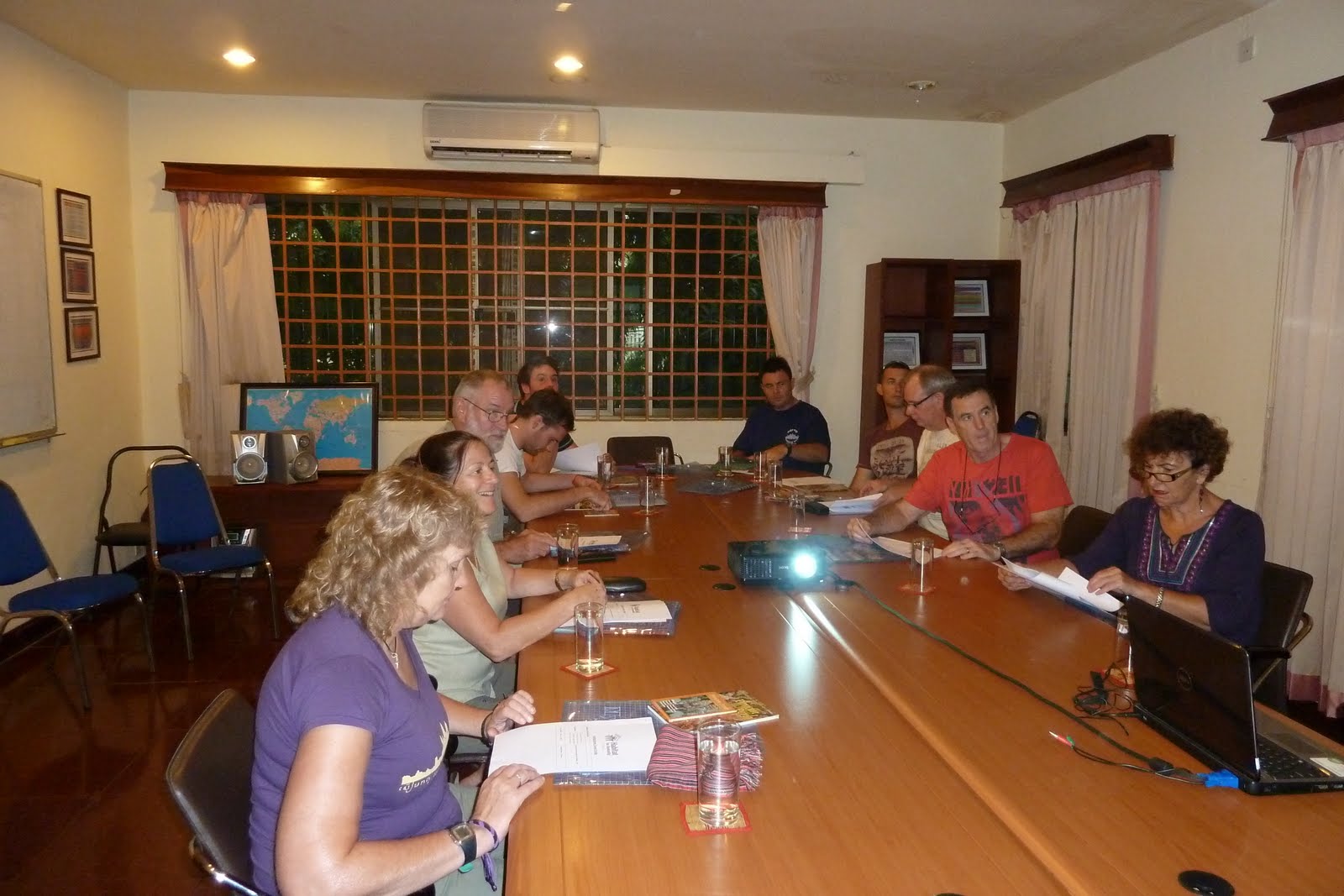
Chum reap suor!  We were picked up by Vitey, our Habitat co-ordinator, and whisked off to a secret location - which turned out to be a local restaurant that had a meeting room upstairs. He explained to us what we would be doing, the families that we would be helping and some of the cultural differences that we should be aware of in our dealings with the community. We had some basic language lessons and learn't how to tie a Cambodia scarf, known as a kroma.
After a welcome buffet lunch, we were brought back to our hotel for a free afternoon. One group went looking for a new camera (a small accident with a tuk-tuk) and the other went for a walk to the river. Interesting back streets and shops, wedding parties and mad drivers. We survived crossing the roads and found a great cafe on the river, which was also home to Mr Toilet Public.

We wandered along the river, past the palace, looking for a good place to eat dinner - there were plenty to choose from, we would not go hungry!
After a welcome buffet lunch, we were brought back to our hotel for a free afternoon. One group went looking for a new camera (a small accident with a tuk-tuk) and the other went for a walk to the river. Interesting back streets and shops, wedding parties and mad drivers. We survived crossing the roads and found a great cafe on the river, which was also home to Mr Toilet Public.

We wandered along the river, past the palace, looking for a good place to eat dinner - there were plenty to choose from, we would not go hungry!
Red Tree Ants & Tarantulas
Phnom Penh moves at a different pace to Siem Reap. Traffic, people, bright lights - we were in the big city! Flight was good, arrived to find our Habitat contact ready and waiting, 45 minutes later we were at Frangipani 60s - and we had the run of the house - just 7 rooms and we had them all. Our host, Sucre, settled us in and then recommended a local restaurant - Romdeng. It is a training school teaching young people the hospitality trade.
Romdeng Website The art work on the walls (by the children) was terrific and the menu interesting. We decided to try some of the local delicacies, and share an assortment of meals. Most dishes were quite acceptable to our western palate - but why stick with the usual stir fries, we ordered Stir Fried Red Tree Ants with Beef & Holy basil and Crispy Fried Tarantulas with Lime and Pepper Sauce. The Red Ants were great, but they had run out of tarantulas - so we will have to go back another night!
Romdeng Website The art work on the walls (by the children) was terrific and the menu interesting. We decided to try some of the local delicacies, and share an assortment of meals. Most dishes were quite acceptable to our western palate - but why stick with the usual stir fries, we ordered Stir Fried Red Tree Ants with Beef & Holy basil and Crispy Fried Tarantulas with Lime and Pepper Sauce. The Red Ants were great, but they had run out of tarantulas - so we will have to go back another night!
Subscribe to:
Posts (Atom)